
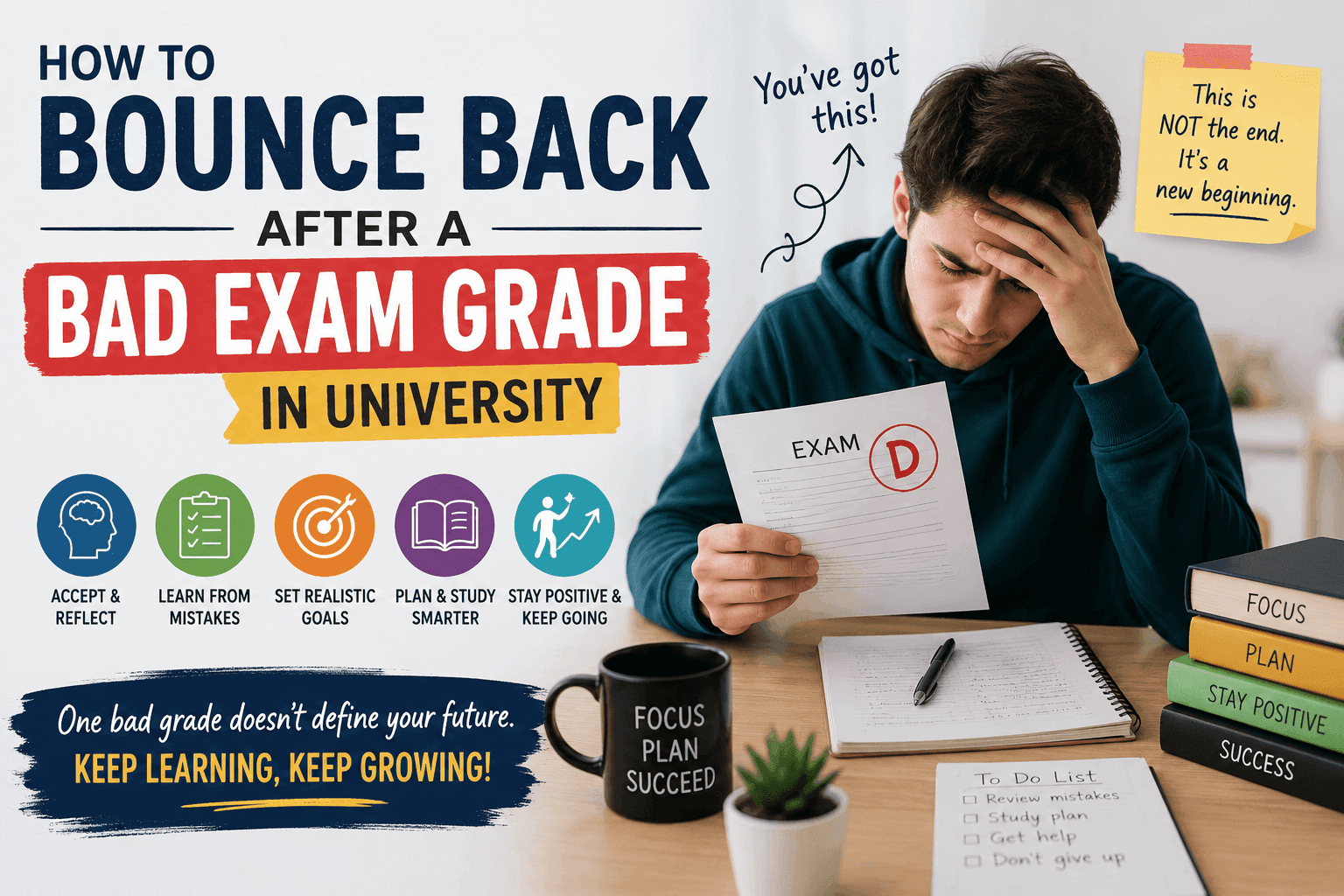
How To Bounce Back After A Bad Exam Grade In University
It may feel much bigger to fail a university exam than it actually is. Just one disappointing result can lead you to thoughts like “Am I going to repeat the year?” or “Will this ruin my degree?” The reality is that it is usually much more manageable.
Universities often have academic regulations for failed assessments, and in most cases, they provide another opportunity for students to demonstrate that they have learned the material. The exact outcome is dependent on your course, your overall marks, the number of credits involved, nd your institution’s rules. This blog is a guide to help you manage failing a university exam.
What Actually Happens When You Fail a University Exam?
If you failed an exam, it does not automatically mean that you have failed your entire degree. Universities often assess modules, progression requirements, credits, and overall academic performance instead of treating one poor exam as the end of your studies.
● You May Only Fail One Module
You should first analyse whether you failed the exam or the entire module, as they are not necessarily the same thing. Modules often contain 60% exam and 40% coursework. If you have performed poorly in the exam and have strong coursework marks, then you may still pass the overall module. This uniqueness is important. You should check your module results instead of assuming the worst from an individual exam score.
● A Resit May Be Your Next Opportunity
Most of the universities provide reassessment or resit opportunities for failed modules, but the format matters. You may sit another exam, complete another form of assessment, or submit a replacement assignment through university assignment help. You can get the first source of information from your student handbook, examination office, or course regulations.
● Your Mark May Be Capped
Institutions sometimes allow students to retake a failed assessment, but they place a cap on the reassessment. This means that your recorded module mark can only rise to the standard pass level if you perform extremely well for the second time. It may sound harsh, but they are designed to differentiate an original successful attempt from a reassessment. This policy can distinguish between universities and sometimes between courses, so you should not assume your friend’s resit rules apply to you.
● You Could Still Progress to the Next Year
If you fail one module, it does not stop you from moving forward. Universities have progression rules according to the number of credits passed and specific modules completed. They often allow students to continue to the next academic year, carrying a failed module that will be recovered later. You should not panic after one disappointing result and look at the total and progression requirements.
● Repeating a Module Can Take Longer
If you cannot qualify for a straightforward resit, then you may need to repeat the module. This may have an impact on your timetable, graduation date, workload, and sometimes your tuition costs. Financial consequences are also crucial. It may involve additional fees according to your university and circumstances. You should ask your academic office about this before you make any assumptions.
● Serious Academic Problems Can Affect Continuation
Repeated failures may look more significant than a single unsuccessful assessment. If you continue to fail modules or do not meet progression needs, your university may place you on academic probation, require you to repeat a year, or in some circumstances, ask you to withdraw from the programme. These outcomes depend on the institutional regulations.
Steps to Take After Failing an Exam
One of the worst responses that students make is that they disappear and hope the problem sorts itself out. You should choose a much better approach to find exactly what happened, understand your options, and make a practical recovery plan.
- Read Your Result: You should first find out the actual mark, assessment weighting, module result, and credit value. Also, analyse whether the result means that you failed the assessment or the whole module.
- Check The University Regulations: You should look for the sections that cover reassessment, progression, academic appeals, resits, compensation, and mitigating circumstances. Rules are different between institutions and even departments.
- Speak To Your Tutor Or Academic Adviser: You need to arrange a conversation with someone who understands your programme regulations. Ask various straightforward questions about resits, caps, progress, module repetition, and deadlines for reassessment.
- Review Your Exam Feedback: Once you understand what will happen next, you should work on the reason for the result. The reason will help you to focus on memorising the information. You should also use the feedback if your university provides it.
- Change Your Preparation Strategy: You should change your strategy to avoid repeating the mistakes you made before. Focus on the revision period around the weaknesses revealed by the exam. You can work through timed conditions, past papers, and explain difficult concepts.
- Make A Recovery Plan: Once you are clear about rules and weaknesses, you should create a realistic timetable for the next assessment. Don’t just rely on spare time, but protect specific study periods. Break complex topics into smaller ones and track what you can actually answer without notes. Students often search for affordable assignment services to better recover their failed module.
Can Failing An Exam Affect Your Final Degree?
If you fail an exam, it may impact your final degree, but it depends on your university’s calculation method and the level at which you fail. The impact will be relatively small if you reassess one module, but repeated failures or a low overall average matter much more.
- Your Overall Average Matters: If you are performing strongly and fail just a single result, then it may not impact your degree. Someone whose results are consistently close to the minimum pass level may affect your overall average. People often look for “do my assignment” to manage their future modules and maintain strong performance.
- Your Graduation Date Could Change: If your failed course is a prerequisite for later study, repeating it may delay your progression. If the reassessment is scheduled after the normal academic year, then it may also affect your final graduation date. Instead of assuming that you will automatically graduate with your original cohort, you should check the reassessment calendar.
How To Avoid Failing Your Next Exam?
If you are changing what you do next, then a failed exam is useful. Your goal should not simply be to study longer, but you should study in a way that directly addresses the reason you struggled.
- Start With The Assessment Criteria: Before you revise, you should identify what the exam will actually test. You should look at learning outcomes, lecturer guidance, marking criteria, and previous feedback. When you know the expected standard, it will make revision much more focused.
- Practice Retrieval, Not Just Reading: If you read the notes repeatedly, it can create a comforting feeling that you know the material. It may be harder to test yourself and usually more revealing. You can close the textbook and explain a concept from memory. Start attempting questions without checking the answer first. Then you can review your mistakes and repeat the process.
- Use Past Mistakes As A Study Map: You check and analyse your mistakes from your previous paper. Practise to build stronger arguments. If you lost marks due to lack of evidence, complete short timed exercises. If timing is the problem, create a focused glossary and test yourself regularly.
- Build Better Coursework Habits: General academic habits and exam performance are not completely separate. The habits of writing, referencing, researching, and understanding course material throughout the semester can help you make your revision easier. Tips to Write University Assignments for Good-Grades can help you encourage better planning, argument development, and close attention to assessment requirements to strengthen your written work.
Frequently Asked Questions
1. Can I still pass the module if I fail one exam?
Yes, you can still pass the module, but it depends on how you assess your module and how much the exam contributes to the final mark. If your coursework, practical work, presentations, and other assessments have enough weight, then you can still achieve the required overall module grade.
2. What can I do if I think the result is wrong?
You should contact the appropriate university office promptly and ask about the formal review or appeal process. Must keep copies of your result, assessment information, feedback, and relevant correspondence. While waiting for someone else to resolve the issue, you should not miss a deadline.
3. Do I need to repeat the whole year if I fail an exam?
No, it is not necessary to repeat the whole year. Most universities differentiate between failing an individual module and failing to meet the requirements for progression. You may be permitted to resit the assessment or carry a limited number of failed credits and also continue with your studies.
Conclusion
It is a setback to fail a university exam, but not automatically a disaster. You may be allowed to resit, have a compensation option, or get the opportunity to repeat your affected module, depending on your university rules. The smartest response is to check your regulations, understand why you struggled, speak with your academic adviser, and prepare differently next time. A single result cannot define your academic ability or future career. What matters now is what you do with the information that result gives you.

Dr. Sarah Mitchell leads the blog at Affordable Assignments, sharing expert insights on effective writing, study strategies, research techniques, and academic best practices. With a PhD in Education and extensive tutoring experience across disciplines, she writes with clarity and authority to help students improve their academic performance, manage deadlines, and navigate common challenges in higher education.